Greater range, higher safety, faster charging and lower weight – FEV and ProLogium present innovative vehicle battery
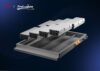
Aachen, December 2024 – Customer requirements for the evolution of electric cars are clearly defined: Weight must be reduced, efficiency and range should be increased. Charging should be faster, and safety needs to be guaranteed at all times. Furthermore, maintenance costs should be reduced. FEV, Germany’s innovation powerhouse for the automotive industry, and ProLogium, a global pioneer in the development of advanced vehicle batteries, fulfil precisely these requirements with their new product development
All this is made possible by LLCB technology (Large-Footprint Lithium Ceramic Battery). With its anode that consists of 100 per cent silicon composite material the latest generation of this battery offers a 10-times higher capacity density compared to the graphite anodes used to date. Depending on the vehicle segment and intended use, the LLCB allows weight savings of up to 300 kg or a maximum range of 1,000 km. In contrary to current liquid electrolytes, the applied solid-state electrolyte is non-flammable and increases safety against thermal runaway. It also prevents potential short circuits caused by leaking electrolyte fluid in the event of a spill.
“For the LLCB solution, we have successfully combined ProLogium´s know-how in the field of cell development with our development, system and testing expertise,” said Dr. Thomas Hülshorst, Global Vice President Electric Powertrain at FEV. “Our collaboration on battery packs and concept designs focuses not only on regulatory standards, but also on market requirements. We even exceed these.”
Compared to current fast charging intervals of around 30 minutes, the silicon anode enables the ultra-fast charging process, which reduces the charging time by more than 80 per cent. This means that the battery can be charged from five to 60 per cent within five minutes, allowing the user to cover an average distance of 300 km. After a further three minutes, the battery is charged to 80 per cent and can cover a further 100 km. In this way, the LLCB helps to bring charging times closer to the duration of a refueling process for vehicles with combustion engines.
The slim shape of the battery cells means that new, space-saving designs can now be realized for the battery packs, which opens up many additional options for OEMs. “The modular design of the battery also makes maintenance much easier, saves costs and allows individual cells to be replaced and recycled,” said Hülshorst. “LLCBs therefore have a positive environmental impact and make a significant contribution to preserving the value of future electric vehicles.”
FEV and ProLogium will continue to develop LLCBs together in the future, as the two companies announced at the Paris Motor Show 2024
About FEV
FEV has always pushed the limits.
FEV is a globally leading engineering provider in the automotive industry and internationally recognized leader of innovation across different sectors and industries. Professor Franz Pischinger laid the foundations by combining his background in academia and engineering with a great vision for continual progress. The company has supplied solutions and strategy consulting to the world’s largest automotive OEMs and has supported customers through the entire transportation and mobility ecosystem.
As the world continues to evolve, so does FEV.
That’s why FEV is unleashing its technological and strategic expertise into other areas, applying its forward thinking to the aerospace and energy sectors. Thanks to its software and system expertise, the company also leads the way making intelligent solutions available to everyone. FEV brings together the brightest minds from different backgrounds and specialties to find new solutions for both current and future challenges.
But FEV won’t stop there.
Looking ahead, FEV continues to push the limits of innovation. With its highly qualified 5,600 employees at more than 45 locations globally, FEV imagines solutions that don’t just meet today’s needs but tomorrow’s. Ultimately, FEV keeps evolving – to a better, cleaner future built on sustainable mobility, energy and software that drives everything. For the company’s partners, its people and the world.
#FeelEVolution
Downloads
As well interesting: Related articles
Below you will find a small selection of similar topics that might also interest you. Take a look.
Software, AI, electrification and robotics: FEV presents innovations for mobility and new applications at Aachen Automotive Colloquium
Aachen, Germany, September 2026 – From October 5 to 7, 2026, the Aachen Automotive Colloquium will celebrate its 35th edition. FEV will showcase the latest technological developments and engineering expertise in software and AI, electrification, and humanoid robotics.
FEV Consulting recognized by Forbes and Statista as one of the world’s best management consulting firms
Aachen, Germany, August 2026 – FEV Consulting has once again been recognized among the world's leading management consulting firms. The company has been included in the World's Best Management Consulting Firms 2026 ranking by Forbes and Statista. The recognition highlights…
FEV collaborates with Microsoft on efficient AI model approach for in-car applications built on NVIDIA
Aachen, July 2026 – FEV, a leading global innovation partner for sustainable and software-defined mobility, is collaborating with Microsoft to integrate powerful, in-vehicle Generative AI capabilities built on NVIDIA GPU-accelerated compute and AI model microservices. The cooperation aims to enable…